alpha · onboarding in small batches
Your Linux box.
Driven from your pocket.
Clone a repo from your phone, watch the dependencies install and the dev server come up on your own machine, and get a live, working preview of the app in your hand.
It isn't remote desktop. There's no shrunken cursor and no laggy screen-share — the phone app is the workstation.
Alpha access is limited — we're onboarding testers in small batches.
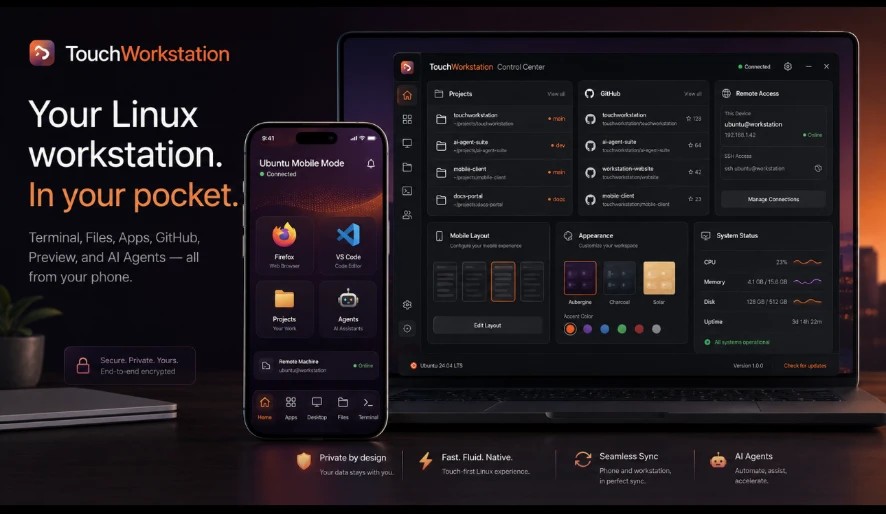
What it actually looks like
Real screens from the current alpha build — phone-first, with a desktop Control Center for the times you do have a keyboard.
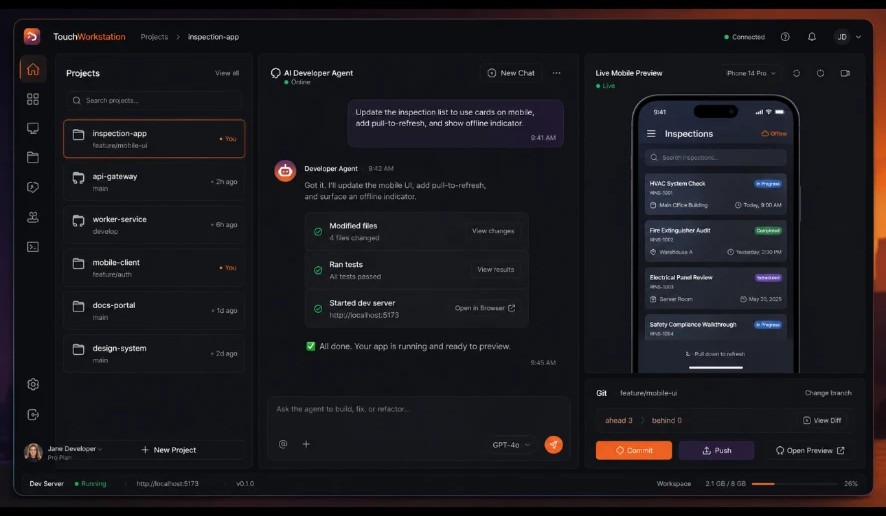
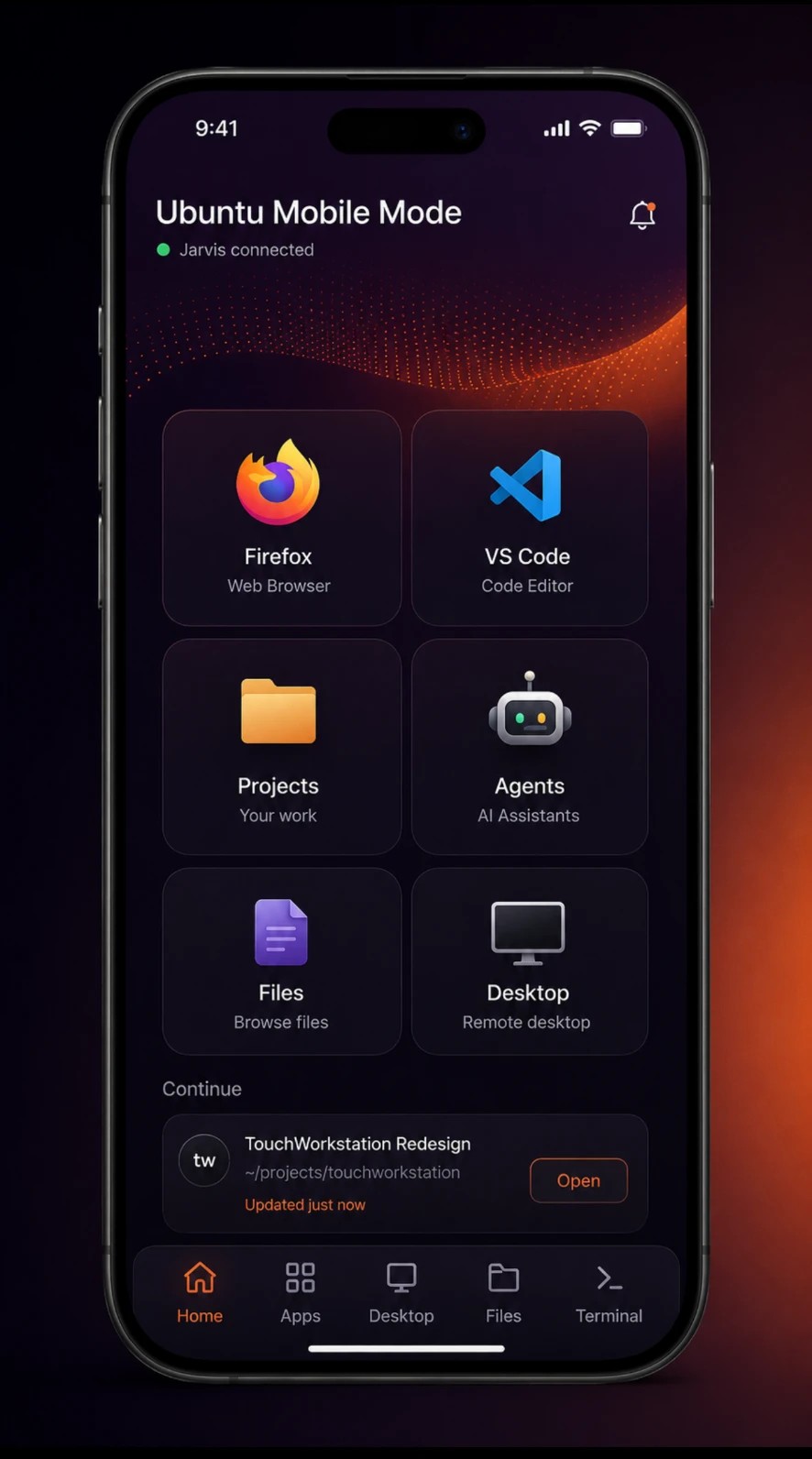
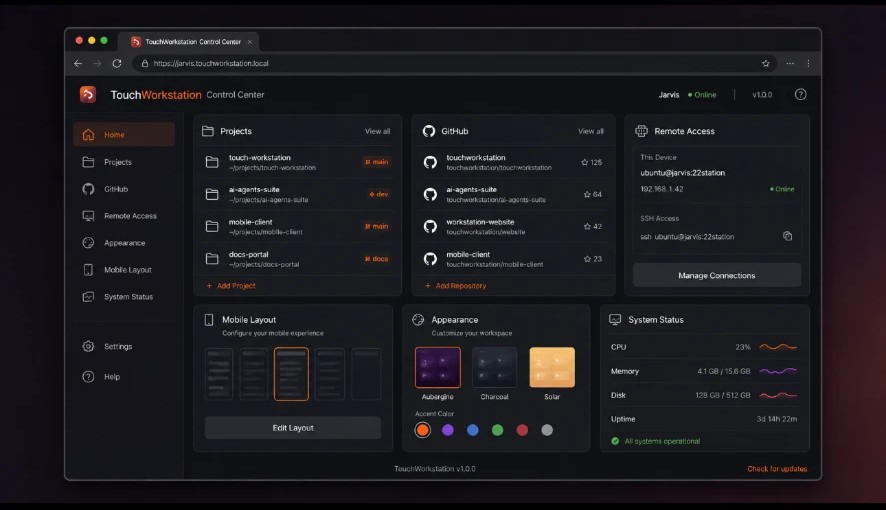
The whole loop, from a phone
Pull a repo. See it running. Point an agent at it. That's the part nothing else does.
- 01
Pull the repo
Pick a GitHub repo on your phone. TouchWorkstation clones it onto your machine — the real one, with your SSH keys and your disk.
~$ git clone git@github.com:you/api-gateway.git Cloning into 'api-gateway'... done. - 02
Install and boot
It detects the toolchain, installs dependencies, and starts the dev server on the box. You watch it happen in a real terminal, not a spinner.
~$ bun install 38 packages installed [1.42s] ~$ bun run dev ➜ dev server ready on :5173 - 03
See it live on your phone
The running app streams to your phone over your LAN or your own VPN. No tunnel service, no public port, nothing routed through someone else's servers.
preview → https://jarvis.lan:5173 exposed publicly: no - 04
Point an agent at it
Attach Claude Code, Codex, or a local model to that one project, with permissions you set. Read the diff, approve it, commit and push — thumbs only.
agent: claude-code · scope: api-gateway
4 files changed · tests passed · push?
“Why not just use VNC or VS Code Server?”
Because pinching around a 1440p desktop on a 6-inch screen is not a workflow, it's a punishment. Remote desktop gives you your machine's pixels. TouchWorkstation gives you your machine's capabilities, in an interface designed for thumbs: real touch targets, real gestures, real mobile layouts on top of real Linux processes.
Browser-based editors also want your code somewhere reachable. This doesn't. There's no public endpoint to leak, no port to forward, no third-party relay holding your source.
network posture
- Runs onhardware you already own
- Reachable overyour LAN or a VPN you control
- Public ports openedzero
- Code stored onyour disk, nowhere else
- Third-party relaynone
What's in the app
Agents scoped per project
Claude Code, Codex, Hermes, or Ollama — each bound to one repo with its own permissions, not one global assistant with keys to everything.
A terminal that survives
A real PTY with persistent sessions. Kill the app mid-build, come back an hour later, your scrollback and process are still there.
One-tap dev tools
A curated launcher for Docker, Postgres, Git UIs, and system monitors. Tap to install it if it's missing, tap to open it if it isn't.
Docker from your pocket
List containers, start and stop them, tail logs — without SSHing in from a laptop you didn't bring.
Live system stats
CPU, memory, and disk from the actual machine, so you know whether that build is thrashing before you queue another one.
Private by design
Everything runs on hardware you own, reachable only over your network or a VPN you control. Nothing is exposed to the public internet.
It's an alpha. Some of it is held together with duct tape.
This got built because the thing didn't exist and waiting for someone else to make it was getting old. Parts of it are rough: some panels are ugly, some flows have sharp edges, and the roadmap changes when a tester says something smarter than what was planned.
Testers get in early, file the bugs that actually matter, and decide what ships next — which distros get first-class support, which agents get wired in, what the terminal gestures should be. If that sounds like your kind of thing, leave your email.
No account, no onboarding call. One email, and an invite when your batch opens.